New preprint on arXiv: a 3-in-1 FPGA unit for pulsed EPR
Graphical abstract
news
Our preprint, “Highly Efficient 3-in-1 FPGA-Based Unit Combining an ADC, DAC, and Multichannel Pulse Generator for Pulsed EPR Spectroscopy” is now on arXiv. Check it out.
Three boxes become one card
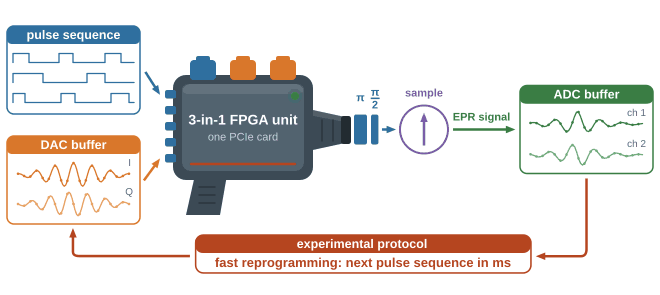
A pulsed EPR spectrometer usually needs three separate instruments to run a single experiment: a pulse generator to open and close the microwave gates, an arbitrary waveform generator to shape the pulses, and a digitizer to catch the EPR signal. Each has its own clock, its own trigger cable and its own idea of when it is ready. We put all three on one PCI Express card: a 16-bit DAC with a 10 GS/s effective sample rate, a 2.5 GS/s 14-bit ADC, and an eleven-channel pulse generator, sharing one FPGA and one sense of time.
The waiting problem
The more interesting part is what happens between the shots. A spectrometer spends its day repeating a pulse sequence thousands of times and adding up the results, and in a conventional setup the instruments sit idle after every shot while the data are read out and the next sequence is loaded. Our firmware refuses to wait: it refills the pulse-generator and DAC buffers and streams the digitized points off the card while the experiment is still running, so no time is lost on data input or output.
How much it buys you
We benchmarked the card with a four-pulse DEER sequence, one of the more demanding things one can ask of a spectrometer, and it stayed close to 100% time efficiency for accumulation times of a few milliseconds per sequence — even with the AWG protocols that usually cost the most. The efficiency turned out not to care about the number of pulses, the number of measurement points, or the depth of the phase cycle, so we expect the same behaviour from any protocol whose shot repetition time is longer than the roughly 2 ms the card needs to reprogram itself.
What it opens up
Because every successive sequence is reloaded from scratch, no two shots have to be alike. That makes nonuniform sampling and acquisition a natural thing to do rather than a special mode: the experiment can decide where to put its next point while it is running. The unit is driven from the open-source Atomize software, so a sequence is written as a few lines of Python code.
Filed under
Tags: Atomize, FPGA, instrumentation, preprint, pulsed EPR
Categories: news